VINTAGE VIEWS: MIRROR LAKE REVISITED

The Grotto and The Spring at Mirror Lake in unmailed c. 1913 postcard. New University Library is up on the hill. |
|
 |
n the early 20th Century, postcards were huge. They were that era’s equivalent of Twitter or texting.
Views of the Ohio State University area were an obvious subject for postcards and Ohio State students were a natural market for postcard manufacturers. Mirror Lake was a popular subject of early 20th Century picture postcards such as these (and these). |
Mirror Lake (or The Spring as it used to be called) is the principal natural beauty spot on campus and a hub of campus life.
According to campus lore, the spring was a deciding factor back in the 1870s in choosing to locate Ohio State where it now stands. A "baptism" in the lake was part of the initiation for many campus fraternities and clubs in the university's early decades. Back before global warming, it was thronged with ice skaters every winter. In the spring & summer, its banks are covered with sunbathers. The lake is the backdrop to numberless snapshots of just graduated seniors. Mirror Lake has been the location of hundreds of weddings and a few suicides. One of the campus ghosts is said to haunt it on lonely winter nights. In recent years, a pre-Michigan Game plunge in the lake has become a tradition for students.
So have a look, read the messages, and step back a century or so to see how much has changed and how much has stayed the same. |
 |
Mailed to: WEST POINT. NY
September 28, 1906 |
|
Hello Jno. Send me a post card, I am starting a collection. |
Beautiful view of the Mirror Lake hollow from the southwest.
Puzzling thing: Why does the caption read "Scene on the Ohio State University Campgrounds?" Campgrounds? What campgrounds? Did they mean "Campus?"
|
 |
Mailed to: PITTSBURGH, PA
September 18, 1907 |
|
| No message. |
View of The Spring with a close-up of The Grotto. Not much different than it appears today.
Note the absence of Main Library up on the hill.
Not sure why the postcard tinter went for the pastel treatment and pink boulders. |
 |
Mailed to: GALENA, OH
October 26, 1910 |
|
| L___ alive but nervous. I saw the whole operation from start to finish... |
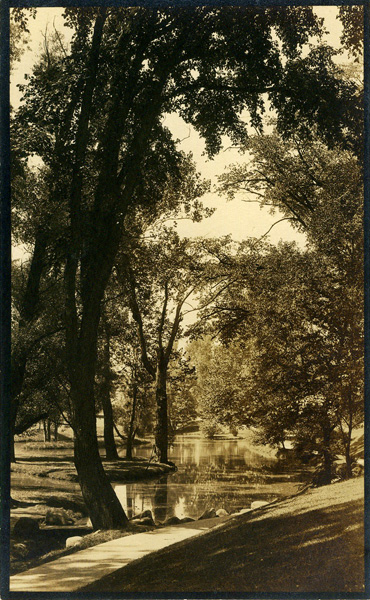
| Pleasant view of the lake on a summer afternoon. |
 |
Mailed to: UNMAILED
around 1910 |
|
| No message. |
Here we have a view from the eastern side of the lake, showing the several islands and peninsulas that used to grace it. A party of women and some local children can be seen seated near the grotto, enjoying a sunny summer afternoon.
The lake has changed considerably since the 1910s. For one thing, the eastern edge of the lake has moved to about where the first island is in this picture. |
 |
Mailed to: UNMAILED
around 1910 |
|
| No message. |
Families with children enjoying the spring on a sunny day. I like the little kid at left sporting the Huckleberry Finn look.
That's a big difference between the University District these were made in and the one today. Families. If you took these pictures today, you'd only see 18-24 year old students and just an occasional parent, staff member, or professor walking through. Very few children. |
 |
Mailed to: UNMAILED
around 1910 |
|
| This little lake extends on out to the spring and is a fine place for the boys to skate in the winter. The observatory is right ahead the spring to your right and Townshend Hall behind you. |
| Footbridges cross Mirror Lake at the western end, near Neil Ave. |
 |
Mailed to: COLUMBUS, OH (from ATHENS, OH)
September 13, 1910 |
|
Arrived all ok but I have the worst cold I have ever had. Will be all right in a few days. |
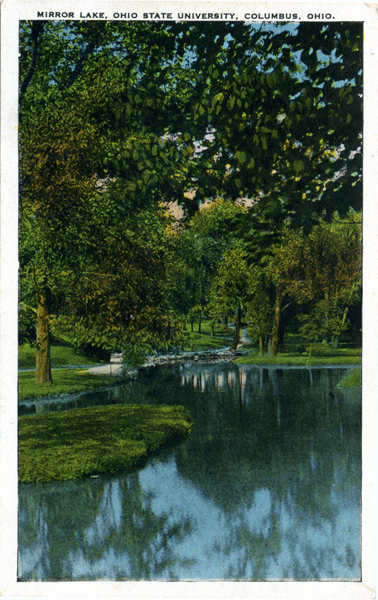
This color image was made by an artist painting over a black-and-white photograph.
The artist took considerable liberties and really upped the colors so it practically qualifies as an original painting. |
 |
Mailed to:UNMAILED
c. 1910 |
|
| No message. |
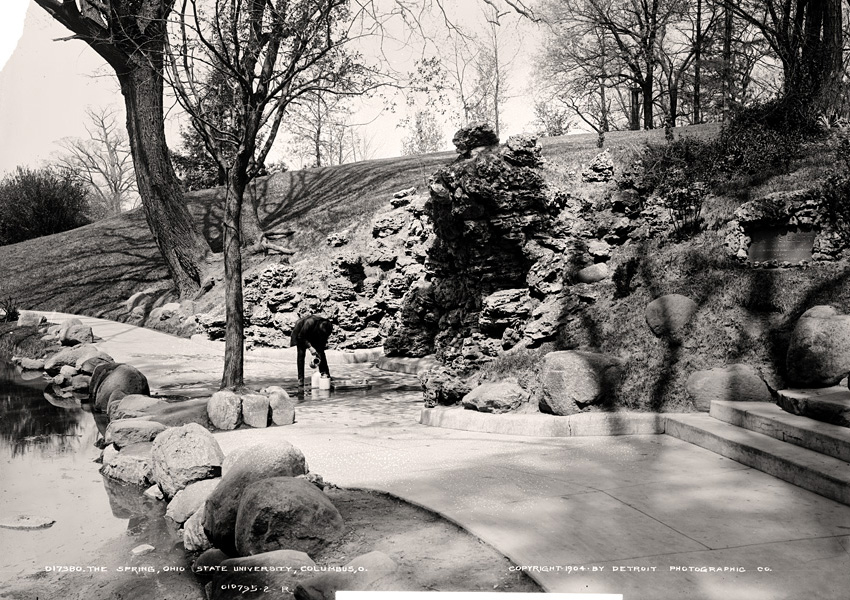
A bunch of fellows--some of them unusually short--stopping by The Spring for a drink. Note the dipper and pail.
Also noteworthy: Look at the big grove of old trees up where Main Library stands today.
A very sylvan view. Looks like a pool in the middle of a forest. |
In 1918, the Mirror Lake shown in these pictures underwent a series of dramatic changes that culminated in the Mirror Lake we know today.
In August of 1918, campus was hit with an epic storm. Winds gusting to 100 mph tore off roofs, wrecked buildings, and knocked over trees. Mirror Lake Hollow was especially hard hit. Huge century old trees were torn up by the roots. The ravine was filled with broken branches and fallen trees. The islands in the lake were severely damaged by the uprootings.
The Mirror Lake that emerged from the storm was different. The overall sylvan look of the place was gone. The ruined islands and broken rustic bridges were removed. The hollow took on a more park-like character.
In the late 1920s, the spring gave out--a victim of development in the Northside. First well water, then river water, and finally city water replaced it. The Classes of 1927, 1929, and 1930 bought a bubbling fountain for the east end of the lake to replace the old spring.
In the Depression years, WPA workers lined the bottom of the lake with brick to facillitate semi-annual cleanings, built stone walls around its edges, and planted trees, flowers, and ornamental bushes. |
 |
|
| No message. |
Mirror Lake looking west towards Neil Ave. Campbell Hall (built 1916) in background.
Seventy-five years later, the area looks much the same. |

|
Images like these get to the heart of why I do this project. Yes, boosting the neighborhood and building identity and awareness are important but it’s also about rescuing lost worlds.
For 100 years, people like you and me have walked these streets and occupied these buildings. Just like us, they laughed, loved, cried, made sandwiches, worked, bathed, screwed, paid the electric bill, read magazines, voted, caught colds, played ball with their kids, ironed shirts, and all the rest.
The streets and buildings are still here but these people and their stories are all vanished. So little remains of them and their world, it’s almost as if they never existed. All the faces, names, events, and places that defined their lives are not just gone but forgotten too.
To rescue these lost worlds from oblivion is part of why I dig out and share these old pictures and old stories. Unearthing and broadcasting that there used to be an amusement park on N. 4th, or Mirror Lake used to have an island, or there was a terrible murder in that house in 1968 recalls these forgotten worlds and their dwellers back to life. It delivers them from obscurity. It reminds us that these people and things were, that they existed, that they mattered.
Hopefully, someday, somebody will do the same for us. |
 |
|