
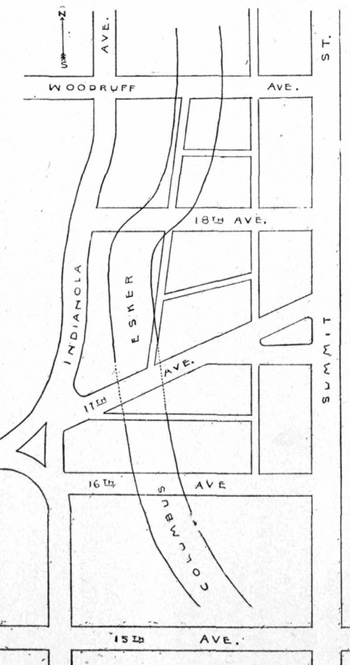
An esker is a ridge of stratified material deposited by meltwater streams flowing through tunnels at the base of a glacier. As these rivers flow, sediment is deposited in layers in their channels just like any other river or stream. When the glacier melts away, this sediment is dumped onto the ground as a long, narrow ridge that traces the former path of the stream. Such features and their origins are well known from recently glaciated lands like Alaska, Northern Canada, Scandinavia, and the Alpine region of Europe. The Columbus Esker was a long ridge, up to 128 feet wide and almost 17 feet in height, meandering between Indianola and Summit. It ran south from the Iuka Ravine to E. 15th. The ridge was continuous except where the 17th Ave. Ravine cut through it. The esker contained alternating layers of coarse and fine sand, clay, river-rounded gravel, and a good many erratic cobbles. If you could have stood on E. Fifteenth, 17,000 years ago, looking north, you would have seen before you a huge, dirty, crumbling ice cliff, stretching away to the east and west as far as the eye could see. Before the ice would have been a barren, frozen landscape of rock, mud, and gravel, dotted with blocks of ice broken off from the glacier. Other than the wind, the only sound would have been water splashing over rocks. At the base of the ice cliff, you would have seen a cave from which a small river of meltwater flowed The Columbus Esker is the ghost of this ancient river. Morse speculated that the esker might have once run much further south but had been destroyed by the construction of the city. Local legend holds that the Neil Mansion was built on an Indian burial mound. Might it have been built on a section of the esker instead? In southern Franklin County remains of a substantial esker parallel US Rt. 23 and run south to northern Ross County and the maximum extent of the ice sheet. The Columbus Esker might be the northernmost part of this feature. Morse documented and photographed the esker and published his results in the February 1907 issue of Ohio Naturalist. The article (with photographs) can be viewed on-line here. After graduating from Ohio State, Morse took a Ph.D. at M.I.T. and went on to head the Geology Department at the University of Mississippi and serve as State Geologist for Mississippi The esker itself is long gone. One searches in vain today for even a trace of it. A century of building and rebuilding have completely obliterated it.
|
|
|
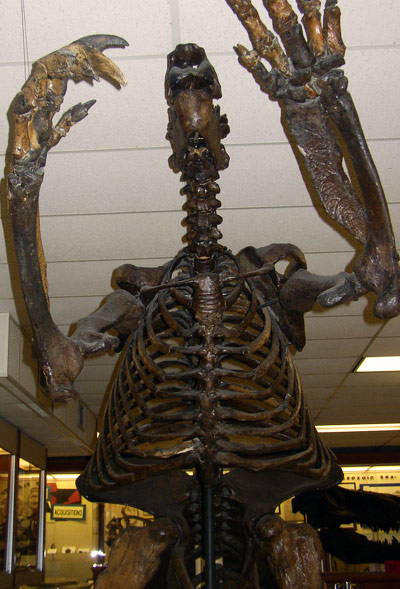
The Ice Age didn't leave behind many fossils in the University District. The soils here aren't conducive to preserving wood or bone for millennia. Most Ice Age fossils turn up in former lakes, bogs, and swamps and, as yet, none have been found in the University District. Elsewhere in Franklin County, conditions were different and remnants of Ice Age life have been found. Botanical remains are most common. Downtown, at Long and 4th St., under 50 feet of glacial till, diggers found a graveyard of ancient spruce trees killed and buried by the advancing ice. Similar buried forests have been found in Gahanna and on the Far East Side. During the construction of Veteran's Memorial downtown, workers found buried spruce trunks that had been gnawed by a beaver of colossal size. Interestingly, these trees tell the story of the changing conditions that brought their demise. In the last 50-100 years of their lives, they show increasingly thin annual growth rings, reflecting the deteriorating growing conditions as the ice advanced on them. Breakage of the trunks shows that most of the trees were knocked down while still living, plowed under by the advancing ice. Ice Age animal remains have also been found locally. In the 1950s, a crew unearthed the skull of a giant beaver near Northern Lights Shopping Center. In life, the beaver would have been the size of a bear. Back in the 1870s, workers at the old Ohio State Penitentiary at Spring and Neil found jaws and teeth of prehistoric American horses. Not far away, a dozen mostly complete skeletons of hog-like peccaries were discovered. Teeth of mastodons and mammoths have turned up occasionally in local deposits. Finds in neighboring counties fill in the picture of life here as the ice was withdrawing. A Clark County mastodon was a long-time campus resident. It was housed in Orton Hall from 1894-1970 before moving to the Ohio Historical Society museum out by the fairgrounds. Another mastodon was found in neighboring Licking County in 1989 with indications it had been butchered by Ice Age humans. Licking County also provides the skull of a woodland musk ox. Megafauna remains have been found in Pickaway County to the south as well. Other sites in Ohio have provided the remains of caribou, bison, stag-moose, giant ground sloths, and the large, fast, and fierce short-faced bear. |
|
In the 14,000 years since the ice withdrew, changes have occurred. Spruce forests gave way to prairies which in turn gave way to deciduous forests. About 12,000 years ago, the first humans entered Central Ohio. Around 12,000 years ago, for reasons that are still a mystery, the mastodons and giant sloths and their exotic brethren went extinct. Gradually, the land, the forests, and the animals came to resemble the place we know today. Through it all, the boulders brought here by the ice have stood silent sentinels. They've seen the mastodon and musk ox come and go, seen Native Americans hunting white-tailed deer through a forested valley, seen early settlers sweat and strain to clear them from new fields, and watched the city of Columbus rise and expand. Now they watch us as we go about our business and live our lives on this land. Who can imagine what they'll see next? |
 |